

How Africans get their news is changing – how much they get might not be
May 5, 2026 - Jeffrey Conroy-Krutz, Komi Amewunou and Kelechi Amakoh
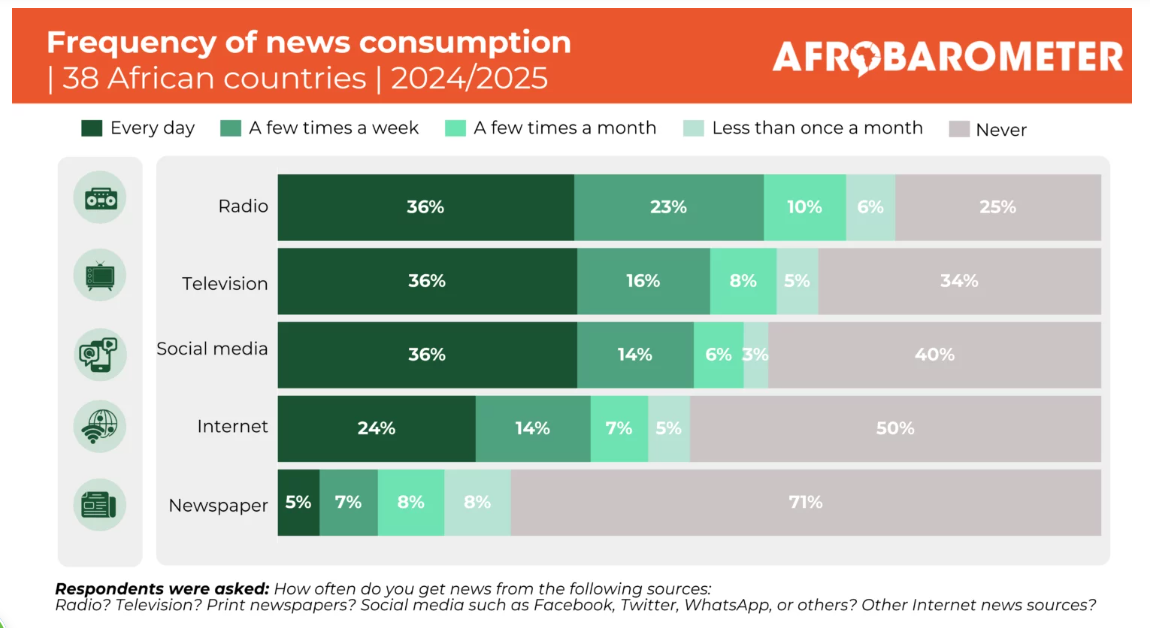 The media landscape continues to change in Africa, as it does in the rest of the world. The rise of digital technologies has transformed how many people obtain information, offering easy and speedy access to those with smartphones and computers (Yu, Bekerian, & Osback, 2024). In response, traditional media have adapted by expanding their presence on digital platforms: Most newspapers, radio stations, and television channels now operate websites or maintain social media accounts through which they distribute their content (Al-Quran, 2022).
How are these changes impacting Africans’ consumption of news and their perceptions of the media and democracy?
Based on Afrobarometer’s 2024/2025 surveys in 38 African countries, we
find that more than eight in 10 citizens across the continent regularly access the news via at least one mass media channel. Radio continues to be the most-utilised medium for news, likely due to its broad accessibility across socioeconomic groups.
However, reliance on radio news is steadily declining. Digital media appear to be displacing the radio and newspapers as news sources for some people, although growth in online news consumption has slowed in recent years.
Africans are broadly supportive of media holding government to account, and they tend to support press freedom over government regulation, but citizen assessments of whether this freedom is protected in their country are mixed. And there is evidence that many may not see a free press as unequivocally good: Support for media freedom is somewhat lower among respondents who perceive their country’s media to be free than those who see it as unfree.
To download the full article, please go to https://www.afrobarometer.org/publication/ad1173-how-africans-get-their-news-is-changing-how-much-they-get-might-not-be/