

There's more to that blue wave in the 2025 elections
December 3, 2025 - Eric Gonzalez Juenke
Dr. Eric Gonzalez Juenke is Associate Professor of Political Science and a 2025-2026 Good Authority Fellow. The original version of this article was published here: https://goodauthority.org/news/theres-more-to-that-blue-wave-in-the-2025-elections/
Nearly 250 years after becoming a state, Virginia elected its first woman governor, Abigail Spanberger, last month. New Jersey elected its second woman governor, Mikie Sherrill, who is the first Democratic woman to hold that office. Lieutenant Governor Ghazala Hashmi became the first statewide elected Muslim official in Virginia, and Zohran Mamdani became New York City’s first Muslim and South Asian mayor. In the Midwest, Mary Sheffield became the first woman to be elected Detroit mayor, and Kaohly Her will become St. Paul’s first woman mayor and the first person of Hmong descent to hold the office.
That’s a lot of historic firsts, just a year after some rollbacks in congressional and state representational diversity in the 2024 elections. The ebbs and flows of representational changes to American government are often understood in terms of racial and ethnic voting. But as I wrote earlier this year, scholars instead are beginning to think about gender, racial, and ethnic underrepresentation as a direct result of how parties recruit their candidates.
This helps explain the many historic electoral wins this year. Democrats have been focused on recruiting a more diverse set of candidates than Republicans for decades. And when Democrats overperform at the polls, legislative diversity tends to increase. In the examples above, the losing Republican candidates were all white men, with one exception: In the Virginia race, Winsome Earle-Sears was vying to become the nation’s first Black woman governor. Her candidacy marked a major historic moment in the country and in the state of Virginia in particular. But equally remarkable was the lack of consistent GOP support for her candidacy. President Trump for example, did not formally endorse her historic, if flawed, campaign.
A closer look at the Virginia and New Jersey races
To look at candidate demographic patterns more systematically, I used Ballotpedia to code the gender, race, and ethnicity of the candidates for State Assembly (in New Jersey) and House of Delegates (Virginia) in the fall 2025 elections.
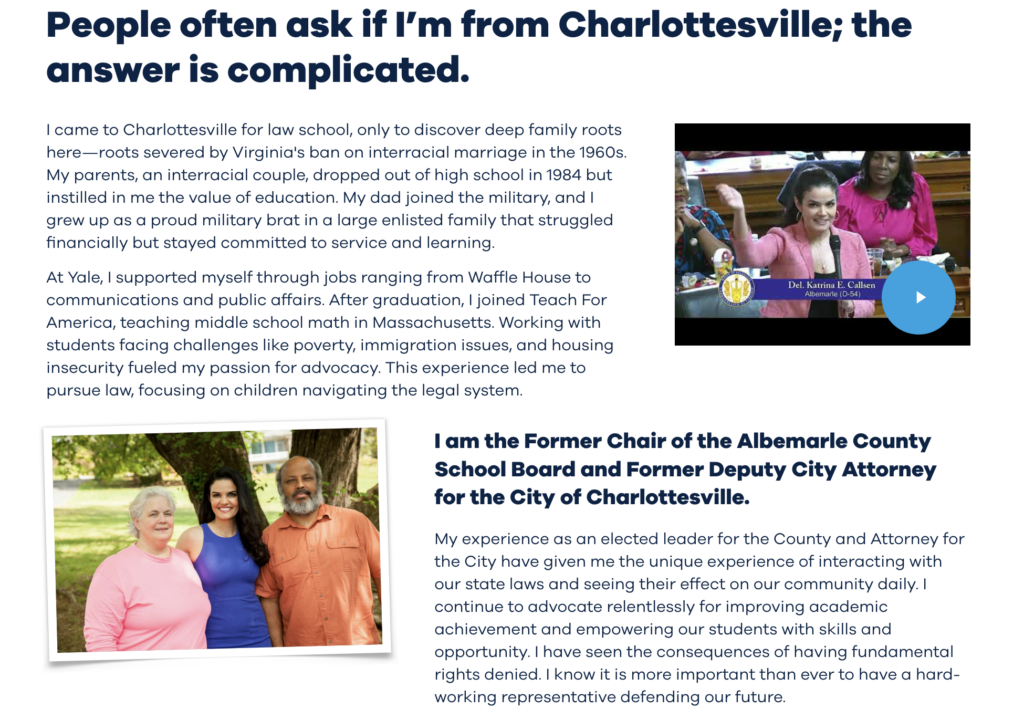
To measure how parties pursued diversity in this election cycle, I followed methods similar to those my colleagues and I have been using for over a decade to code candidate demographics. We investigate a variety of sources, including published interviews, news stories, and self-identification, to code these demographics. For example, one of the best ways to find out about a candidate’s racial and ethnic background is to look at the candidate’s website. For Virginia delegate candidate Milad Mikhail, for instance, his immigrant story was a big part of his public campaign. And Sam Rasoul, another candidate for the Virginia House of Delegates, also highlighted his own immigrant journey. For Katrina Callsen, her identity as a biracial child featured in her public campaign, as the screenshot below shows.
What can these candidates tell us about the parties?
What do the data for these 140 elections in Virginia and New Jersey show? Something old and something new: The results in Virginia look like what we would expect from the two parties, given past research. Democrats did well at the polls, and these elections produced gains in the demographic diversity of elected officials. The Democratic ballots looked very diverse, with white men making up only 1 in 4 candidates this year, close to their roughly 30% share of the state’s population. Indeed, women of color candidates (28%) made up a larger share of Virginia Democrats than white men, something I haven’t seen in our data before. Future research will explore why this was the case – perhaps this reflected changing Democratic voter preferences, increased ambition and recruitment, a “Kamala Harris effect,” or strategic decisions from state party leaders.
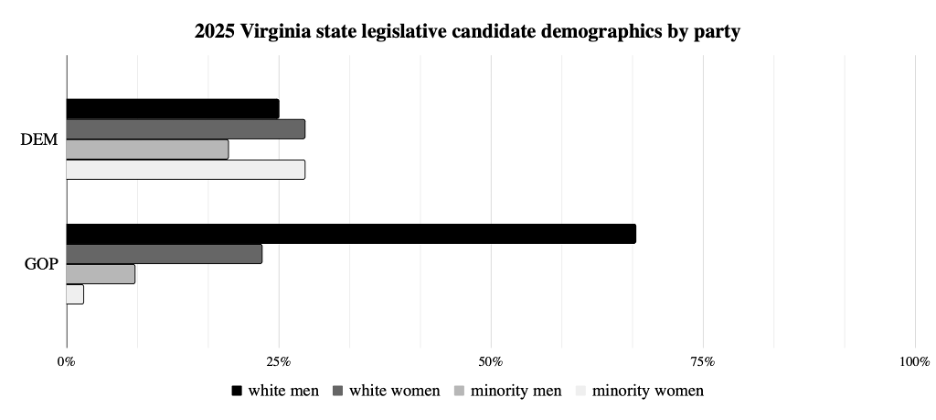
In contrast, the Virginia Republican ticket didn’t look like the state of Virginia’s population. Nearly 90% of the GOP candidates were white and about 70% of candidates were white men. The state itself is about 60% white. Further, 75% of this year’s GOP candidates were men. Had 2025 had been a Republican wave year, we would likely have seen a reversal of diversity tides in the House of Delegates.
The story in New Jersey is very different
In New Jersey, by contrast, voters saw one of the most diverse Republican slates of candidates I can remember in our data. This is likely the result of recent concerted recruiting efforts in the state. New Jersey is one of America’s most diverse states. While Republicans still lag behind Democrats, and neither party is fully reflective of the state’s diverse electorate, the percentage of white women and minority men candidates this year were almost identical across the two parties.
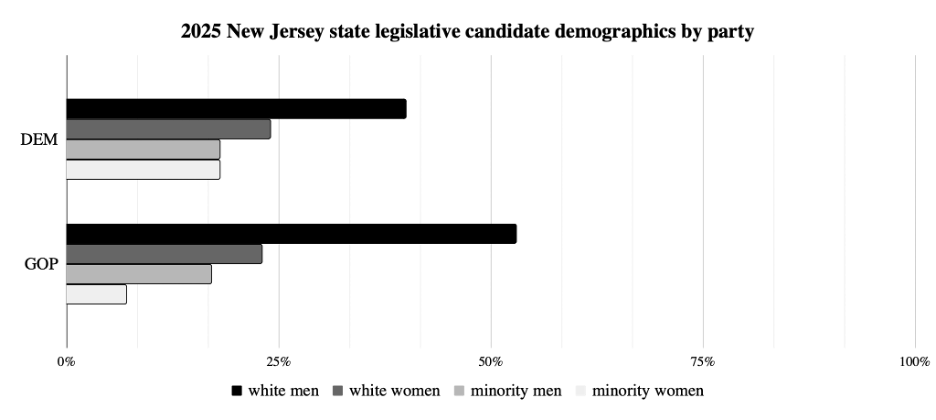
The gap between the two parties reflects the lack of women of color in the Republican slate of candidates. Indeed, the numbers were worse for Republican winners in the 13 elections where the party won the seat. Out of the 22 winners (New Jersey elects two people per district, and some districts split by party), there were no women of color Republicans – and 70% of the GOP winners were white men. Many of the minority GOP candidates were running as challengers in heavily Democratic areas and lost handily. Nonetheless, if the GOP had won in a wave year, their state legislative coalition would be much more diverse than it is currently. The differences across the New Jersey and Virginia electoral results are striking, and likely reflect both geographic-partisan variation and state party recruitment efforts.
These state legislative elections provide important information
These results are important for a few reasons. First, they give us a vision of the near future as the 2026 midterm elections begin in earnest. Candidates for Congress are already campaigning. If the parties continue to run substantially different slates of candidates, we will likely continue to see diversity gains in Democratic wave years. In contrast, Republican wave years will likely see stagnation or declines in diversity in Congress. This means the next congressional demographic profile is being set now, long before voters show up to the voting booth, and it will be determined largely by voters’ partisan preferences next fall.
The 2025 results are also important for elections farther in the future. Many members of Congress began their careers in a state legislature. Some of these recent Virginia and New Jersey winners are in the middle part of their careers, aiming for a higher state office and/or a national seat in Congress in the future. A look at these data gives us some insights on the uneven and partisan nature of representation in Congress in the next decade and beyond.
We might see consistent representational gains in the future, if both parties recruit diverse candidates to run for office. For now, uneven recruitment has created different tides of party-driven representation. If 2026 ends up being a Democratic wave year, as some experts forecast, look for more stories of historic firsts – and perhaps the most diverse U.S. Congress in history.
Eric Gonzalez Juenke is a 2025-2026 Good Authority fellow.